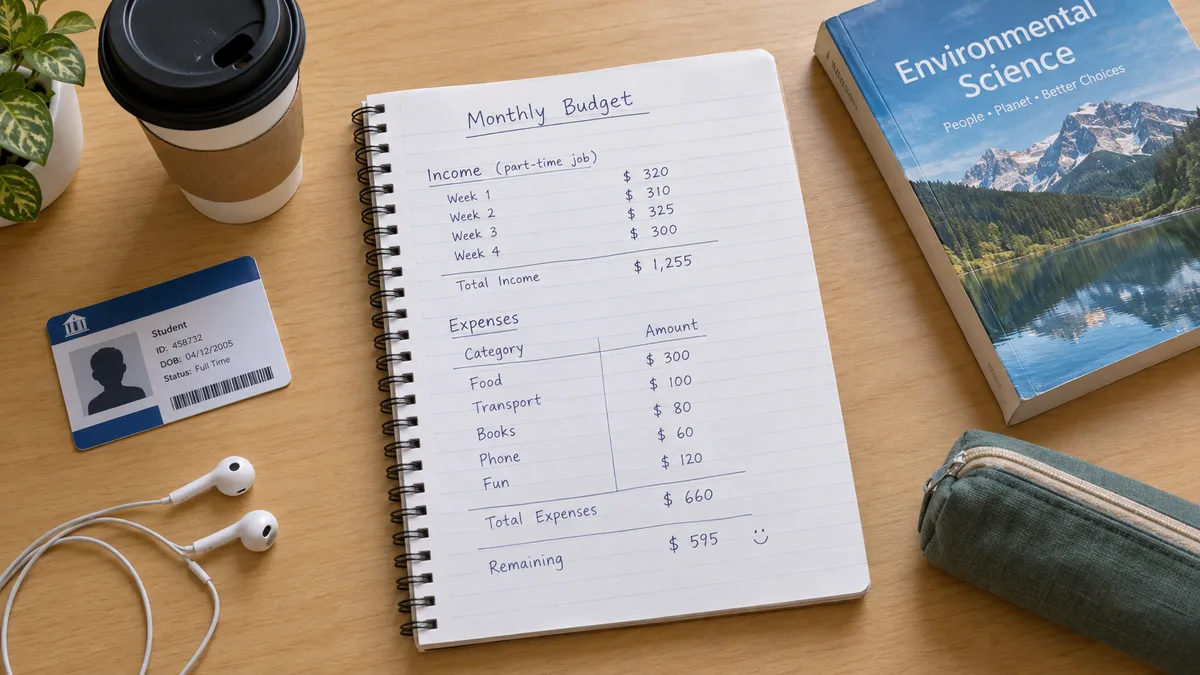
Student money does not arrive like a salary. It comes in lumps - a loan disbursement, a grant, help from family, a part-time job that vanishes during exams. And it goes out in lumps too: tuition, books in week one, rent by the term. A college budget is really two budgets stitched together: the big per-term picture and the small weekly one. This guide builds both, with a worked example and a spreadsheet setup that takes one evening.
Most student money is per-term, so budget per-term first. List the money coming in this term: loan or grant disbursements, family support, savings you plan to spend, expected job earnings. Then list the big per-term costs that are NOT monthly: tuition and fees, books and supplies, travel home, society or club fees, the deposit on next term’s housing.
Subtract the big costs from the big income. What remains is your spendable term money - divide it by the number of weeks in the term and you have your real weekly budget. This one calculation prevents the classic October-rich, February-broke cycle.
Food (groceries plus the honest eating-out line). Housing and utilities if not in halls. Transport. Phone. Books, printing and course materials. Subscriptions (student discounts help, they do not make things free). Laundry and household bits. Societies, sports and nights out - if fun has no line, it eats the food line. Personal care. And a small buffer, because something always comes up.
Two traps to avoid: treating the loan as income to spend rather than money to last the term, and forgetting the one-off costs (books, travel, society sign-ups) that all land in the first fortnight.
Say the term math leaves $340 a week, roughly $1,360 a month. A workable split: food $420 (cook five nights, out two), rent share and utilities $560, transport $60, phone $25, books and materials $50, subscriptions $20, societies and fun $150, buffer $75. Total: $1,360.
Notice the fun line is real, not aspirational-zero. A student budget with no fun allocation does not produce a frugal student - it produces a broken budget by week three. The buffer is what keeps a surprise from becoming overdraft.
If you work part-time, treat exam weeks in advance: plan your budget on your normal hours, and put the surplus from good months into the buffer so a fortnight of revision does not create a shortfall. Variable income budgets fail when every month is planned as if it were the best month.
Same logic for summers: if you will work full-time in the break, decide in June what that money is FOR - next term’s rent, an emergency cushion, travel - and move it somewhere you will not casually spend it.
Student budgets survive on one habit: a weekly check, same time, twenty minutes. Open your banking app, put the week’s spending into the categories, compare with the plan, adjust next week. Not guilt - just steering. If food ran over because parents visited and you fed everyone, that is fine; you move money from fun and carry on.
Sunday evening works well: the week is closed, the next one has not started. Pair it with something pleasant and it sticks.
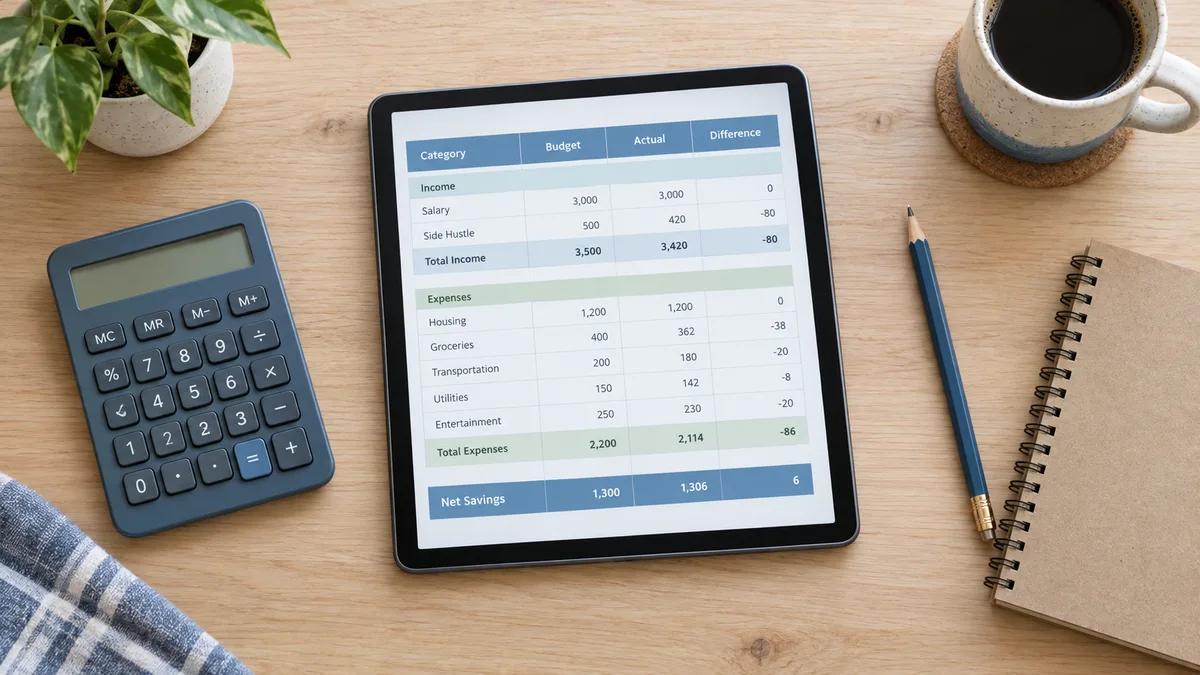
One tab for the term: income sources, big one-off costs, and the weekly-rate calculation. One tab for the months: category columns, planned vs actual, a difference column that turns red when a category runs over. That is the whole system - two tabs, honest numbers, weekly check.
If you would rather start with the structure pre-built, our budget templates have income, category columns, planned-vs-actual differences and the monthly summary already wired up. One copy link puts your private version in your Google account - and if you are budgeting for the first time with pocket money or a first job, our teen budget worksheet covers the same habits in an even simpler layout.
Start per-term: total your income (loans, grants, family, job), subtract the big one-off costs (tuition, books, travel), and divide the rest by term weeks for a weekly budget. Then track weekly spending by category and review for twenty minutes each week.
It depends on city and housing, but the method matters more than the number: cover housing and food first, set a realistic fun amount, keep a small buffer, and make the total match what the term math actually gives you per week.
Books and course materials, printing, travel home, society and club fees, laundry, and the first-fortnight pile-up when several one-off costs land together. Give each a line, even a small one.
Budget it per-term first. Loans arrive in lumps but must last months, so divide by term weeks to get your true weekly rate - spending it like monthly income is how students run out by week eight.
Cook most nights with one or two planned meals out, use student discounts deliberately, buy textbooks used or share, and keep a real fun line so the budget does not collapse. Cutting waste beats cutting joy.
the teen budget worksheet for first-time budgeters · the budget spreadsheet with planned vs actual built in · choose your split with the budget percentages guide · how to budget money from zero

How to use Google Sheets from zero: cells, formulas, formatting and sharing, explained with small real examples. No jargon, no prior Excel needed.
How to make a spreadsheet from a blank grid: plan the columns, add formulas, format it clean, and turn it into a reusable template. A 15-minute build.