
Ten thousand in a year sounds like a personality change. It is not. It is $192 a week - about $27 a day - moved before you can spend it, plus a plan for the weeks that go wrong. This guide does the maths properly, compares the three methods people actually use, and shows where the money hides in an ordinary budget.
Ten thousand a year is $833 a month, $192 a week, $27 a day. Write those on the first row of your tracker and the goal stops being abstract. Nobody can plan "ten thousand"; everybody can judge whether this week can spare $192.
For a £10,000 goal the split is £833 a month or about £192 a week - the coincidence makes the maths easy to remember whichever side of the Atlantic you budget on. Everything below works identically in any currency.
Flat is the default: the same $192 every week for 52 weeks. It is the easiest to automate and the easiest to survive, and for most people it is the right answer.
Escalating starts small and grows - $50 in week one, adding a little each week. It suits people whose income rises through the year, but the heavy final months sink more plans than low motivation ever has. Front-loaded flips it: save hardest in January while motivation is fresh and ease off for the holidays. If you choose anything other than flat, write the whole schedule into the sheet on day one, so November-you is not negotiating with a number January-you invented.
The money almost never comes from skipping coffees. It comes from the fixed-expenses audit: insurance renewals you auto-pay, subscriptions you forgot, the phone plan you never renegotiated, the account quietly charging fees. An hour with three months of statements routinely finds $50 to $150 a month for people who swore they had nothing left to cut.
Our fixed expenses list guide walks through that audit line by line. Whatever it finds is the foundation of your weekly $192 - money that needs no willpower because it never reaches your spending account again. The rest of the gap comes from one or two spending categories, not from being miserable across all of them.
Willpower is a terrible savings mechanism and automation is a nearly perfect one. Set a standing transfer for the day your pay lands - weekly if you are paid weekly, monthly if monthly - into a separate account you do not look at daily. A high-yield savings account in the US or an easy-access account or ISA in the UK earns interest while staying out of sight.
The order matters: save first, spend what remains. People who save whatever is left at month-end reliably discover the answer is nothing, because unallocated money evaporates into ordinary life.
Every savings plan dies the same death: an annual insurance bill, a wedding, car repairs, Christmas. These are not surprises - they are scheduled ambushes. The defence is a sinking fund: a small monthly amount per known future cost, kept in its own line so the "emergency" never touches the 10k pot.
List everything irregular you paid in the last twelve months, add it up, divide by twelve. That figure sits in your fixed savings alongside the $833. It feels like it slows the goal; in reality it is the thing that lets the goal survive contact with the year.
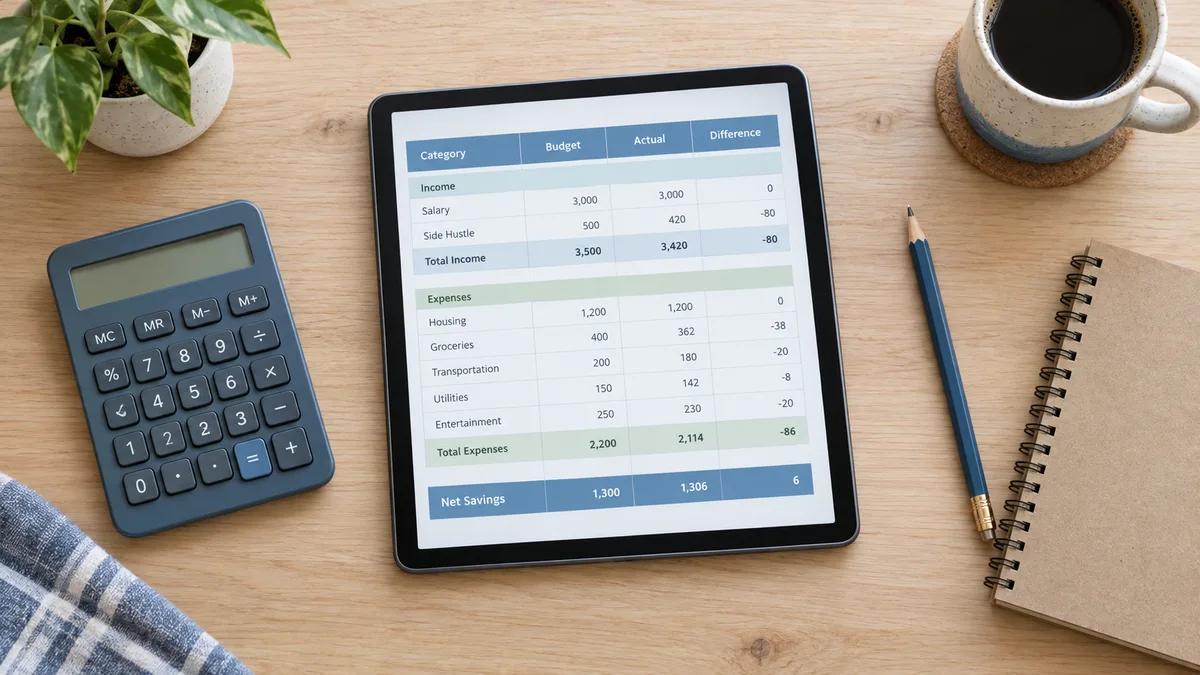
Log the transfer every week - one row, ten seconds. The savings tracker template has exactly this structure: one row per deposit, a running total, and the goal line drawn in so you can watch the gap close.
Once a month, compare actual to plan. If a month collapsed - illness, a slow client, an honest overspend - spread the shortfall across the remaining months and keep going. The plans that fail are not the ones that missed a month; they are the ones that treated a missed month as proof the whole thing was hopeless. Ten thousand in a year is not a test of character. It is a spreadsheet and a standing order, repeated fifty-two times.
About $192 a week, $833 a month, or roughly $27 a day. In pounds that is around £160 a week or £690 a month for a £10,000 goal. The weekly number matters more than the yearly one - it is the one you can actually act on.
It is a good habit-builder, but the classic version only reaches about $1,378 in a year. Scaling it to 10k makes December brutally heavy. A flat weekly amount is easier on real budgets; escalating suits people whose income grows through the year.
Somewhere separate from your spending account and earning interest: a high-yield savings account in the US, or an easy-access savings account or ISA in the UK. Separate matters more than the rate - money you cannot see in your main balance is money you do not accidentally spend.
Spread the shortfall across the remaining months instead of doubling the next one. Missing once and adjusting is normal; doubling up and failing twice is how the whole plan gets abandoned.
the savings tracker with the goal line drawn in · the fixed expenses list audit, line by line · choose your split with the budget percentages guide · how to budget money from zero

How to use Google Sheets from zero: cells, formulas, formatting and sharing, explained with small real examples. No jargon, no prior Excel needed.
How to make a spreadsheet from a blank grid: plan the columns, add formulas, format it clean, and turn it into a reusable template. A 15-minute build.